UK Nature Carbon, Made Clear Knowledge share series
Once you start delving into the UK nature markets to see what opportunities are on offer, you’ll notice the projects that are heralded as ‘investment ready’ – but what exactly does this mean, and what stages of work have been undertaken to get a nature-based carbon project to this stage?
In this article we share the art of UK nature-based project development, and reveal the science, skill and nuance of this complex process that often takes two to three years to complete.
We share the flexible framework that is typically applied in the project development of UK nature-based solution projects. This includes our own projects, from Revere’s large single landowner peatland restoration project in the Cairngorms to our multi-landowner woodland creation project in the South Downs. There is often cross over between the stages and the approach must always be adapted in response to the unique needs of each project and its stakeholders.
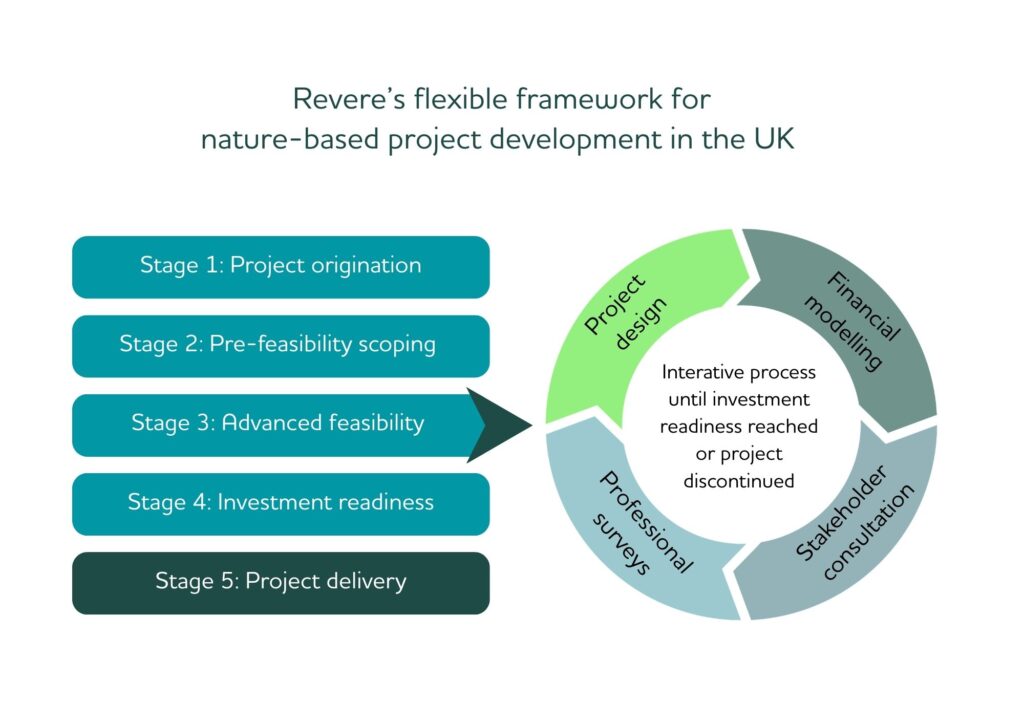
Stage 1: Project origination
The origination of nature restoration projects is often a gradual process over many months that requires:
- Building an understanding of the needs and motivations of the landowner/s and other stakeholders, such as National Park Authorities.
- Early information gathering and site visits.
- Envisioning and mapping the ecological opportunity and nature benefits.
- Assessing the most appropriate funding route/s, which could be philanthropy, grant support, or private finance.
- Undertaking due diligence to ensure ethical standards are met.
- Building cross party consensus.
Many initiatives start long before they are formally recognised as carbon or nature-based solutions projects. Projects often arise from strategic priorities such as climate resilience, biodiversity recovery, and landscape-scale restoration, or in response to regional challenges such as water pollution. Early on, the question is whether the opportunity can be structured as a commercial nature-based solutions project, or if it will be better suited to philanthropic partnerships.
Stage 2: Pre-feasibility scoping
Once a project has been identified as a nature-based solution opportunity, more detailed pre-feasibility scoping is undertaken to clarify whether a project is viable. This stage typically includes:
- Mapping opportunities for interventions or habitat creation, such as woodland cover potential.
- Identifying risks or constraints, such as limited local supply of saplings for tree planting, or the presence of existing high value habitats that must be conserved.
- Identifying potential markets for the ecosystem services generated and eligibility for relevant codes, for example the Woodland Carbon Code.
- Running initial ecological and financial models. While some projects pass this stage quickly, for others it may reveal significant constraints. Issues arising such as landowner uncertainty, the presence of legal designations such as a Site of Special Scientific Interest (SSSI), or unsuitable soil or habitat can halt development. Importantly, this stage provides an early decision point: whether to move forward with private finance, pursue other forms of funding, or pivot to alternative plans.
Investors may be engaged during this early stage to test the early proposals and seek support for the resource-intensive advanced feasibility stage.
If it is agreed that a project is to progress to the next stage for private finance, a set of Heads of Terms is normally agreed between the main parties. At this stage the parties are likely to be the landowner/s and the project developer, but they may also include investors and public agencies. Heads of Terms are non-binding but set out the key points on which a future contract will be built, and ensure everyone is on the same page before the project progresses to the survey and design work.
Nature-based project development requires deep ecological and financial knowledge combined with quiet determination, diligence and a willingness to listen and adapt plans in response to feedback.
Stage 3: Advanced feasibility
If a project advances beyond pre-feasibility scoping, the full feasibility phase of work begins. This stage is resource-intensive and can take many months into years, depending on the size and complexity of the project and site. Funding for this stage of the project development may come via donations, grant funding or perhaps even from early investment.
i. Professional surveys
This stage requires multiple technical surveys to be undertaken by Chartered professionals. These surveys are vital to build a more detailed understanding of the baseline condition and characteristics of the site, and its suitability for restoration. Depending on the type and scale of the project there may also be regulatory requirements to meet, such as the completion of an Environmental Impact Assessment (EIA).
Surveys may include:
- Archaeological surveys of any historical features in the landscape.
- Bird surveys – particularly in areas known to be used by waders or raptors, conducted through repeated ecological visits.
- Vegetation survey – identifying valuable or sensitive habitats that must be preserved.
- Soil surveys – including light pit digging to determine soil type, especially where peat may be present.
ii. Project design
Once the surveys are complete, the findings can be used to inform more detailed project design: setting out where and how nature interventions will be undertaken. This in turn will enable a more accurate assessment of the ecosystem services that the project will deliver. These could include climate or biodiversity benefits that can be quantified as ‘credits’, as well as ‘co-benefits’ such as improved air quality or soil health.
Community and local employment co-benefits are also central considerations at this stage. These can include providing farmers with a new income stream, enhancing public access, investing in local infrastructure that improves engagement with nature, job creation in organisations such as National Park Authorities, or employment for local groundworks contractors and nurseries.
The highest integrity projects not only deliver nature-based solutions like carbon sequestration but also strengthen rural economies and community resilience. This dual purpose helps to ensure long-term support and shared value.
iii. Financial modelling
Alongside ecological design, financial modelling is undertaken to determine whether a project is financially viable and can provide not only the ecological but the financial returns necessary to meet stakeholder needs.
Practical land management tasks and costs such as fencing, herbivore management, deer and livestock management, tree planting, and long-term maintenance must be carefully modelled. Insurance and risks, such as fire, must be factored in.
Carbon credit volume is calculated along with projected revenues and must be stress-tested against future price scenarios.
Financial modelling is a highly skilled and complex process that must also factor in externalities such as tax, subsidies, and inflation. It includes a deep understanding of the ‘buy side’ of investable nature projects – investors and corporate off takers – and must take into account their needs relating to levels of return, risk, time frames and integrity.
Some projects are premised on one site, but others such as Revere’s South Downs Woodland Carbon project, require the aggregation of a number of sites and their individual budgets into one overarching financial model.
Every project must balance financial viability with ecological integrity. Investors expect returns, but projects must deliver genuine biodiversity and community benefits.
iv. Stakeholder consultation
Ensuring regulatory compliance
Consultations with statutory bodies such as the Forestry Commission, NatureScot, and National Park Authorities are integrated with the design and financial modelling work. This ensures compliance with UK Forestry Standards and environmental regulations. Timelines can vary widely, with some projects requiring years of consultation, especially if they are large-scale.
Securing future funding
Ongoing consultation with investors is crucial during the advanced feasibility process to ensure that the final project design and model are attractive and thus financially viable.
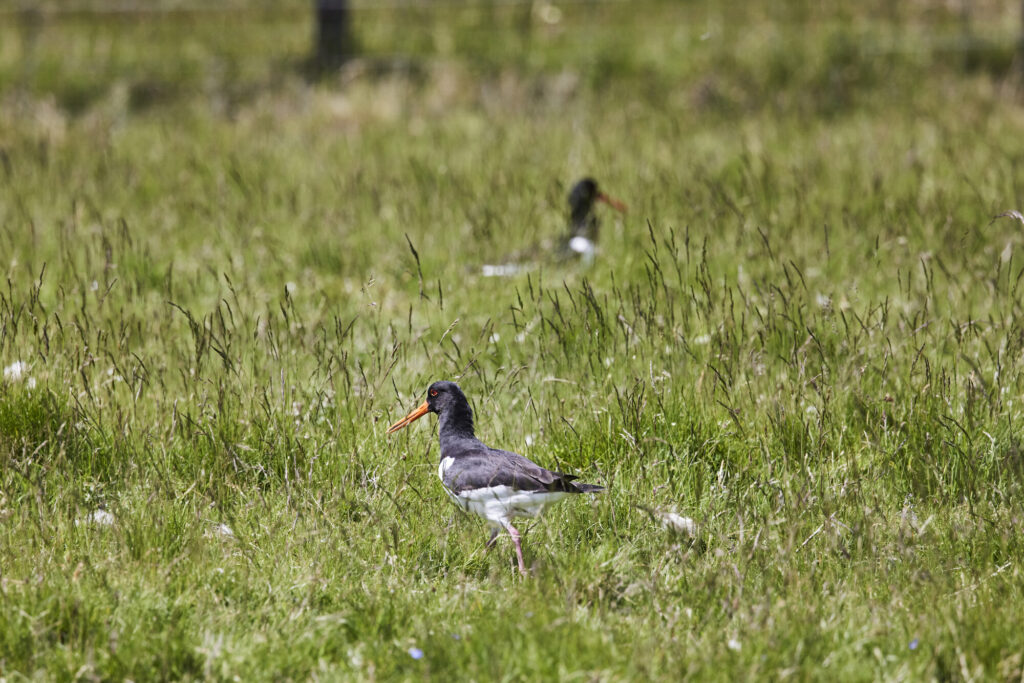 Credit: Ed Smith
Stage 4: Investment readiness
Once these detailed feasibility studies are complete and the stakeholders are confident in the project’s design and model, the final stage of the project is to match the project with an investor and/or corporate off takers.
At this ‘investment ready’ stage, investors will be expecting to see robust financial modelling, as well as information on all aspects of the project design, including the project’s risk management, governance, monitoring and auditing processes.
It is likely that the project team will also be engaging with companies seeking offsets to offer forward purchase agreements or secure upfront finance, which can help to mitigate risk for investors and lock in a good carbon price.
Once investment has been secured, the landowner/s will enter into long-term contractual agreements, typically lasting between 25 and 40 years. These contracts formalise commitments to the delivery and management of the nature restoration work and protect the long-term legacy of the project.
Long-term outcomes
The project can now start delivering for nature, creating resilient ecosystems that sequester carbon, restore biodiversity and benefit local communities. Independent auditors verify compliance at set points in time with the relevant standard, such as the Woodland Carbon Code that requires verification in year five and at least every ten years thereafter. This ensures that projects are delivering the carbon storage promised and provides opportunities for landowners to earn additional credits if growth exceeds projections.
Other forms of measurement and reporting are also deployed depending on the specific projects aims, for example water quality testing and species monitoring, and these are reported back to stakeholders.
The ultimate goal of UK nature carbon projects is to create resilient ecosystems that sequester carbon, restore biodiversity, and benefit local communities. At the end of the contractual period, landowners inherit mature, well-established habitats. They may choose to continue carbon credit verification, keep credits for their own net-zero commitments, or sell them to generate additional revenue.
This long-term perspective underpins the investment case and provides reassurance to landowners and communities that projects deliver enduring value beyond short-term funding cycles.
Conclusion
Getting a nature carbon project to investment readiness requires a rigorous process from origination and feasibility to design, consultation and long-term modelling. Private finance, whether in the form of return-seeking investor capital or finance from companies seeking to acquire carbon credits, is only available to projects where risk, return, legal and governance elements have been modelled in depth.
The challenge is that the process of getting projects to investment readiness is resource-heavy and not easily funded. It requires partnership working across landowners, investors, public agencies, philanthropies and communities. Our Revere project development work demonstrates that high integrity nature carbon projects can be designed to ‘investor grade’ standards as well as creating a more resilient UK landscapes for the future.
As we start to see initial investment into our portfolio, this creates a strong demand signal and will leads to the development of further investable nature projects across the UK.
This insight article is by Revere, a UK National Parks and Palladium collaboration that scales nature-based solutions across the UK National Parks.
To find out more contact
ross.powell@thepalladiumgroup.com or lisa.sensier@nationalparks.co.uk